RESDAL contributes to amplifying the role of the UN Conduct and
Discipline Service within peace operations
With
the support of the Elsie Initiative of Global Affairs Canada, on
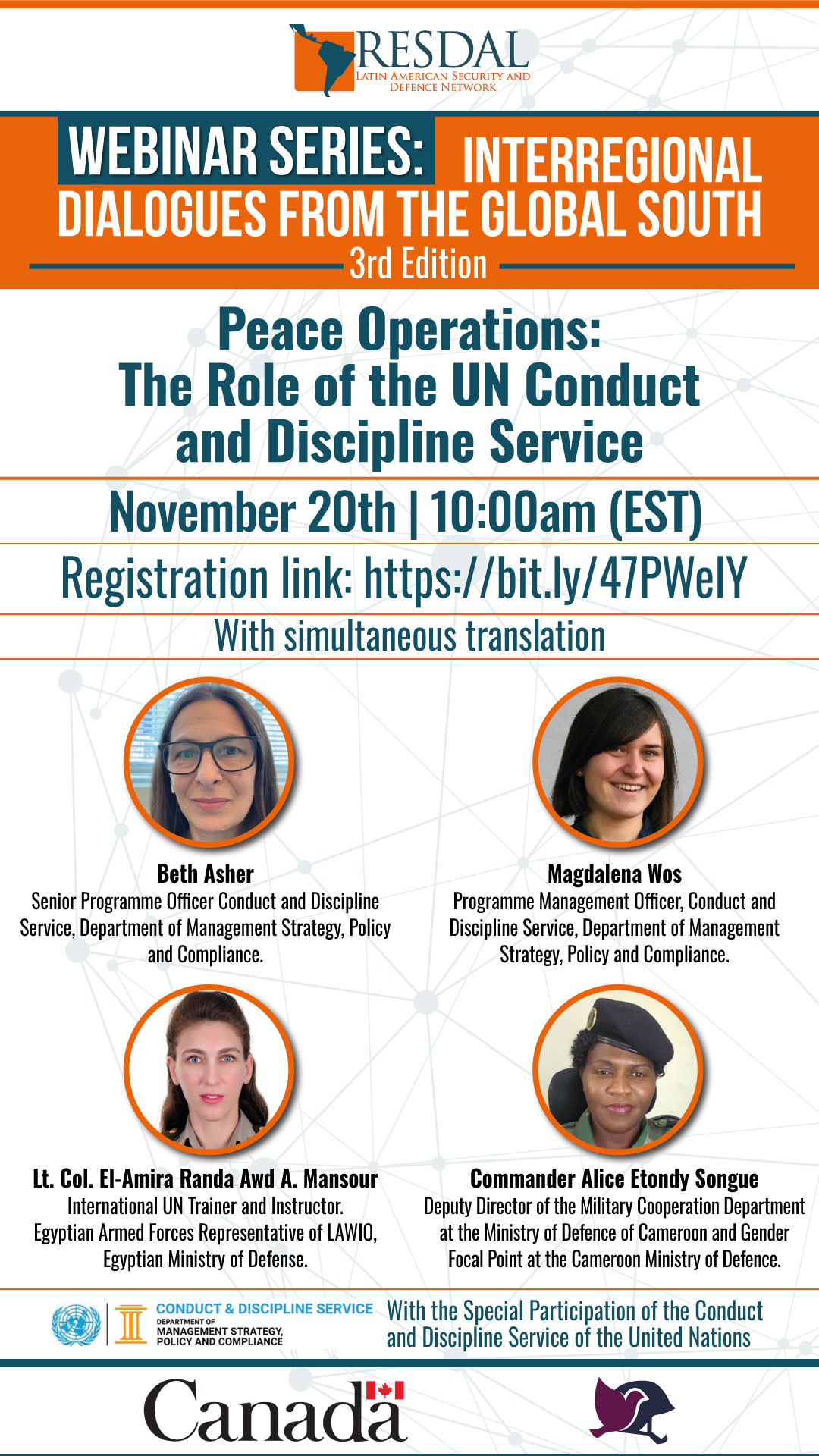
November 20 RESDAL held the webinar “Peace Operations: The Role of the
United Nations Conduct and Discipline Service.” Moderated by specialist Cecilia
Mazzotta, the event formed part of the series “Interregional
Conversations from the Global South,” a cycle promoted by RESDAL within the
framework of the project Women in Peace Operations: Supporting Inclusive
Environments through Interregional Collaboration and National Engagement.
Driven and organized by
RESDAL since 2024, this series has helped strengthen South–South and
South–North cooperation and has demonstrated the importance of maintaining
spaces for exchange around the Women, Peace and Security agenda. The
activity brought together more than 400 participants from 53 countries,
representing armed forces, judicial institutions, government agencies, UN
entities, civil society organizations, academia, and independent
experts—evidence of a growing interest in understanding and improving conduct
standards in peace operations.
Moderated
by Argentine expert Cecilia Mazzotta, the session sought to explore the
challenges involved in preventing and responding to sexual exploitation, abuse
and harassment in operational contexts, particularly from a Global South
perspective.
Specialists
from the UN Conduct and Discipline Service, Beth Asher and Magdalena
Wos, provided a clear overview of the normative and operational frameworks
that govern personnel conduct in peace missions. They recalled that the UN
Charter requires particularly strict standards for all categories: civilian,
military, police and contractors. They also explained how the organization
structures its response to sexual exploitation and abuse through three core
pillars.
The
first pillar is prevention, supported by systematic training and
risk-management tools. The second is accountability, which requires
troop- and police-contributing countries to carry out the corresponding
investigations. The third is victim assistance, which both specialists
described as the most difficult to implement. The diversity of contexts, the
specific needs of each case and the legal obstacles that persist across
jurisdictions make this pillar the most fragile of the system.
Asher
and Wos further emphasized the complexity of addressing paternity cases involving multiple jurisdictions. They also highlighted the persistent
structural gaps in social, health and legal services in many operational
environments—factors that continue to hinder the ability to provide rapid,
adequate and sustainable responses for victims.
Perspectives from Cameroon and Egypt
The
webinar also offered a comparative view from two troop-contributing countries: Cameroon and Egypt. Cmdr. Alice Etondy Songue outlined Cameroon’s approach
in missions such as MINUSCA and MONUSCO, which relies on a firm zero-tolerance
policy reinforced through mandatory training in all military schools and
through the role of the Senior National Investigation Officer,
responsible for acting immediately upon reports of possible SEA. Songue
underscored that sanctions may include disciplinary and criminal measures, as
well as salary withholding in confirmed paternity cases. However, she
acknowledged persistent obstacles such as underreporting due to fear or
distrust of institutional channels, and the difficulties victims face in
accessing reparations. In this context, Cameroon is exploring new reporting and
support mechanisms, including anonymous hotlines.
Lieutenant
Colonel El-Amira Randa Awd A. Mansour presented Egypt’s experience,
where UN conduct standards are deeply embedded in national military doctrine.
She described a victim-centered approach that includes scenario-based training,
cultural sensitivity and a gender perspective. She explained that Egypt
maintains accountability mechanisms through its military justice system and works in close coordination with the UN to expedite reporting and
investigations. She also stressed the importance of early engagement with local
communities and the deployment of female interpreters, whose presence,
she noted, significantly contributes to abuse prevention and to strengthening
trust.
A global reach
The
wide geographic distribution of participants reinforced the seminar’s genuinely
interregional character. From Latin America and the
Caribbean, participants joined from Argentina, Bolivia, Brazil, Chile,
Colombia, Costa Rica, Cuba, Ecuador, El Salvador, Guatemala, Haiti, Honduras,
Mexico, Nicaragua, Panama, Paraguay, Peru, the Dominican Republic, Uruguay and
Venezuela. From the African continent, participants joined from
Cameroon, Egypt, Ethiopia, Ghana, Kenya, Liberia, Morocco, Nigeria, Rwanda,
Senegal, Sierra Leone, South Africa, South Sudan, Tanzania, Togo, Tunisia,
Uganda and Zambia. The Asian
region was represented by India, Indonesia, Nepal, Pakistan, the
Philippines and Sri Lanka. Europe and North America contributed
participants from Canada, the United States, Spain, France, Italy, the
Netherlands, Portugal and the United Kingdom. Additional participation came
from Turkey, Qatar and the United Arab Emirates, bringing the
perspective of the MENA region.
Throughout
the webinar, it became clear that—beyond normative frameworks—the challenges
associated with SEA carry a strong human dimension: fear of reporting,
cultural barriers, lack of information and the complexity of
cross-jurisdictional responsibility. Both national experiences and CDS
perspectives underscored that community trust, institutional leadership,
rigorous training and international cooperation are essential to advancing
towards safer and more accountable peace operations.
There
was broad agreement on the importance of sustaining interregional spaces for
dialogue and mutual learning, such as those promoted by RESDAL. The
convergence of voices from multilateral bodies, state institutions and civil
society enabled the articulation of shared priorities aimed at transparency,
professionalism and the protection of those who serve — and those who are
served — within peace operations.